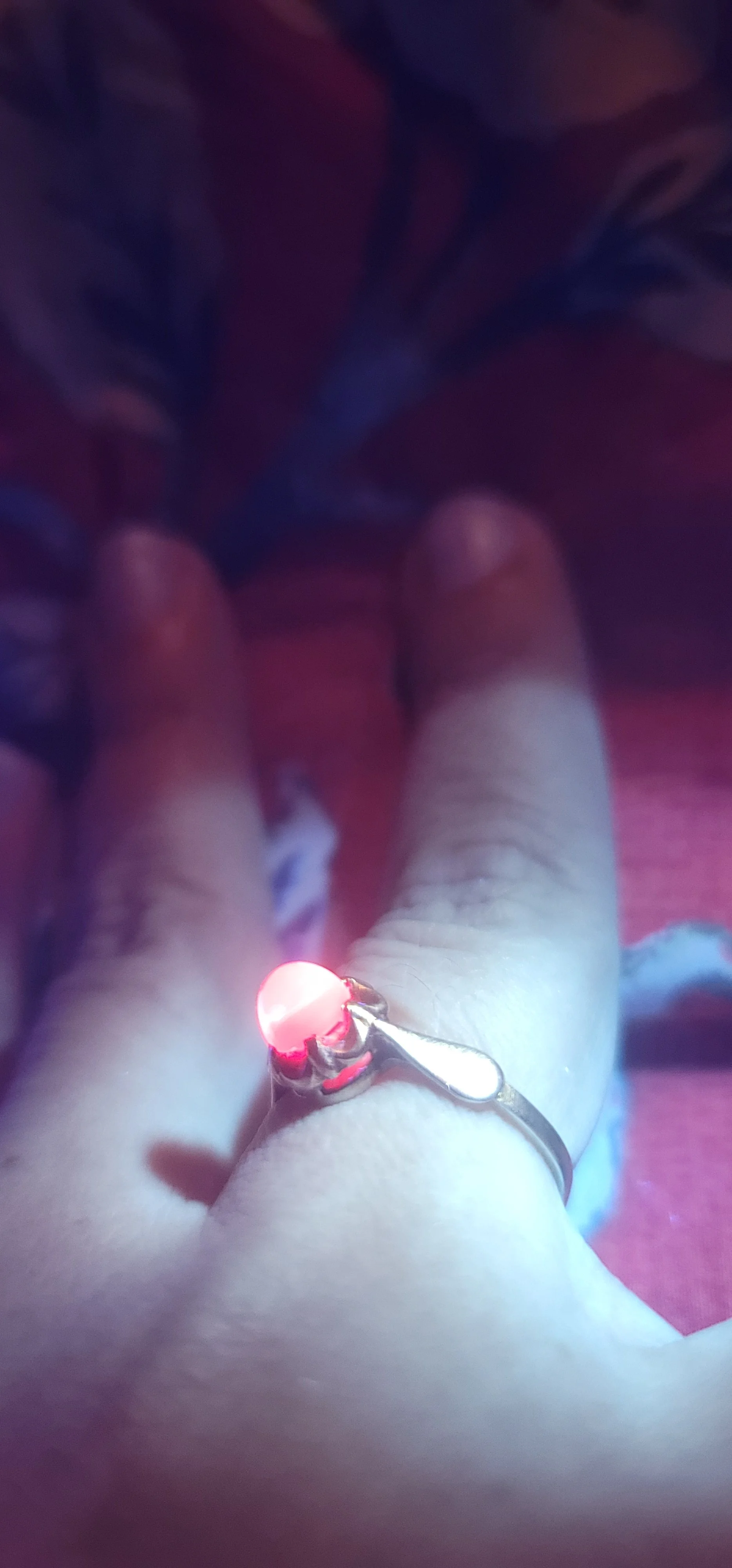
Why does my ruby ring glow red in sunlight?
Because sunlight is passing straight through a very clean stone and coming back out saturated red. The setting is open underneath the stone, so when the ring is held up to a window, light can take that path straight through as well. The stone is a flame-fusion ruby, grown in a lab: optically clean, evenly colored, and free of iron, so light travels through it instead of scattering, and the red you see is intense. It is a real effect, it has a real explanation, and honestly the explanation is more interesting than magic would be.
The ring itself
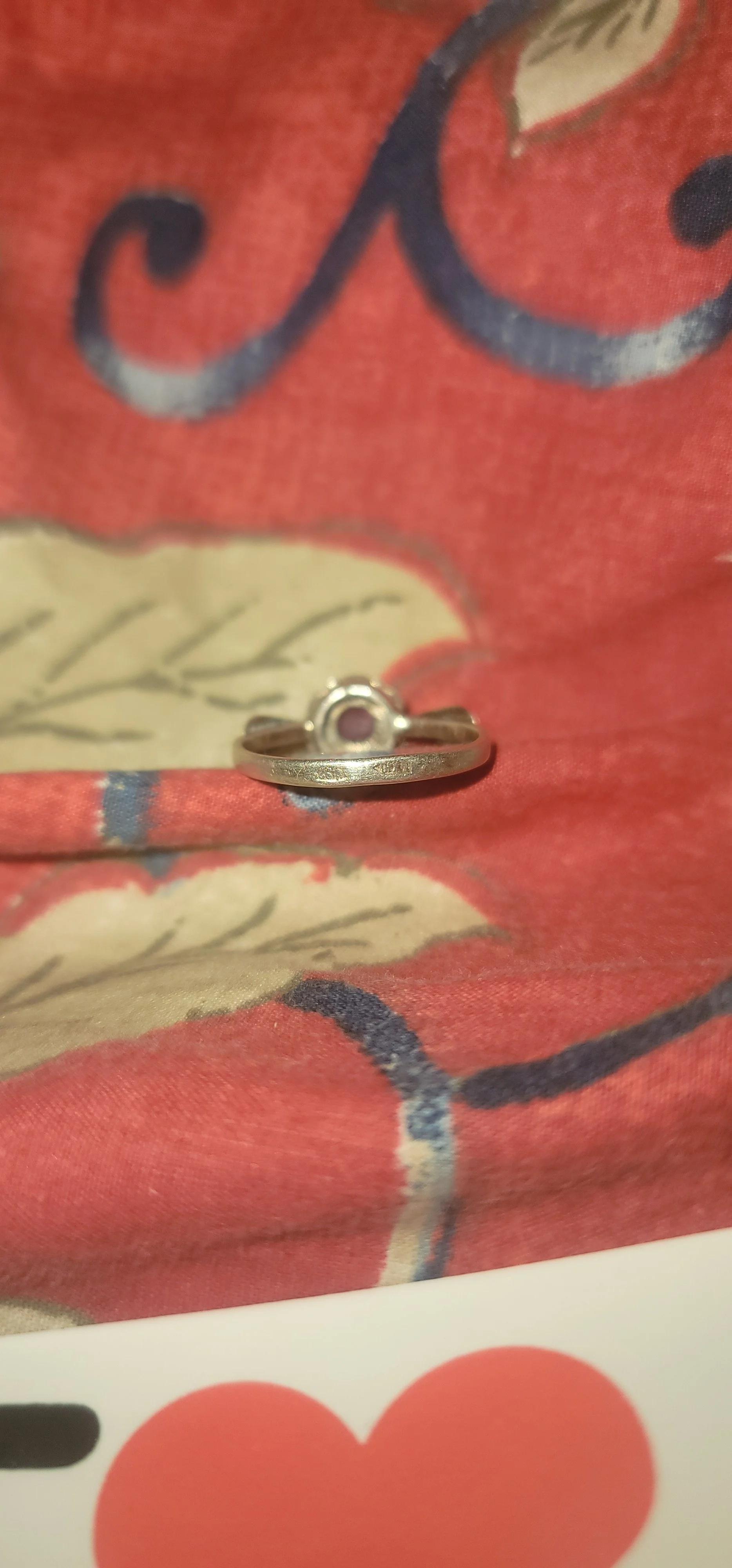
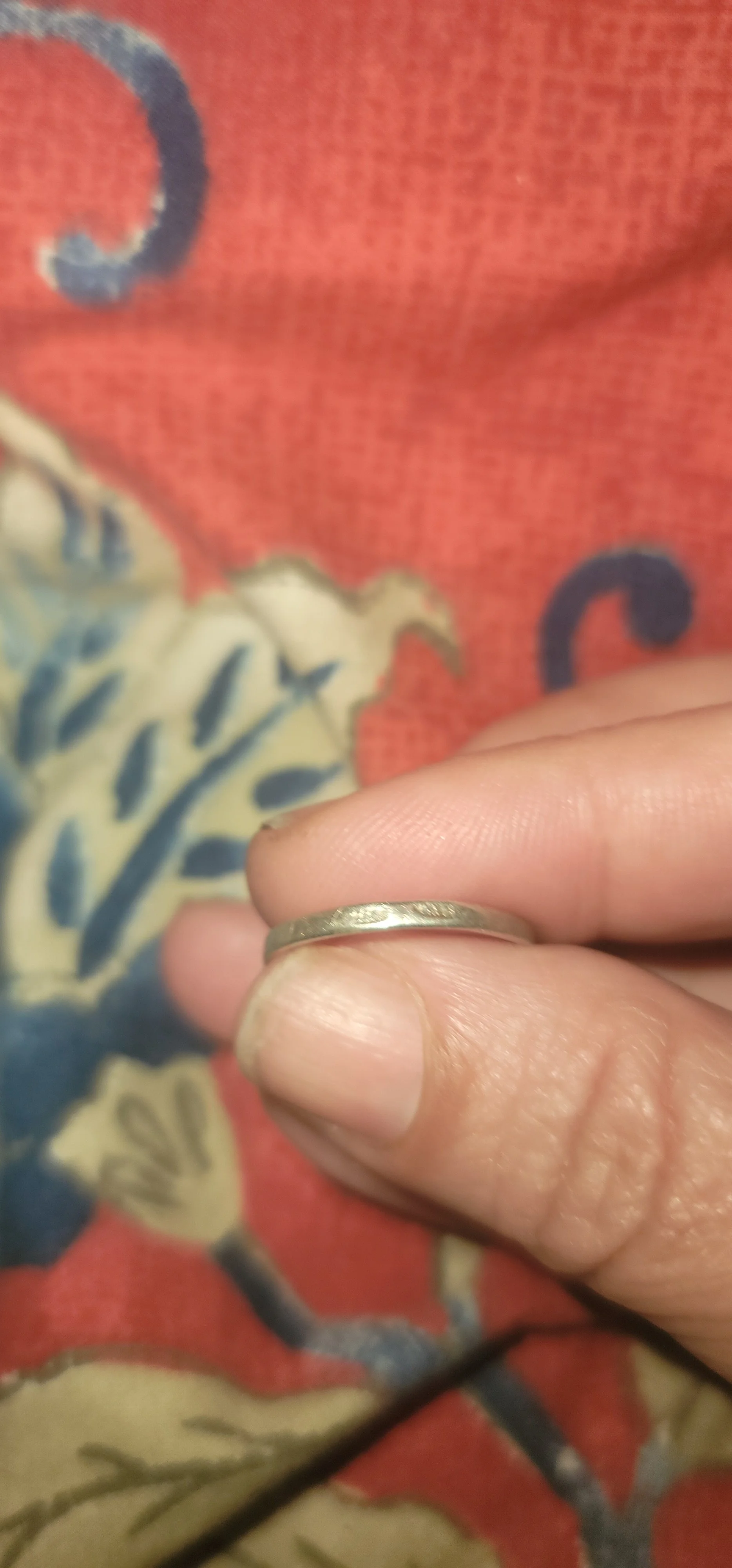
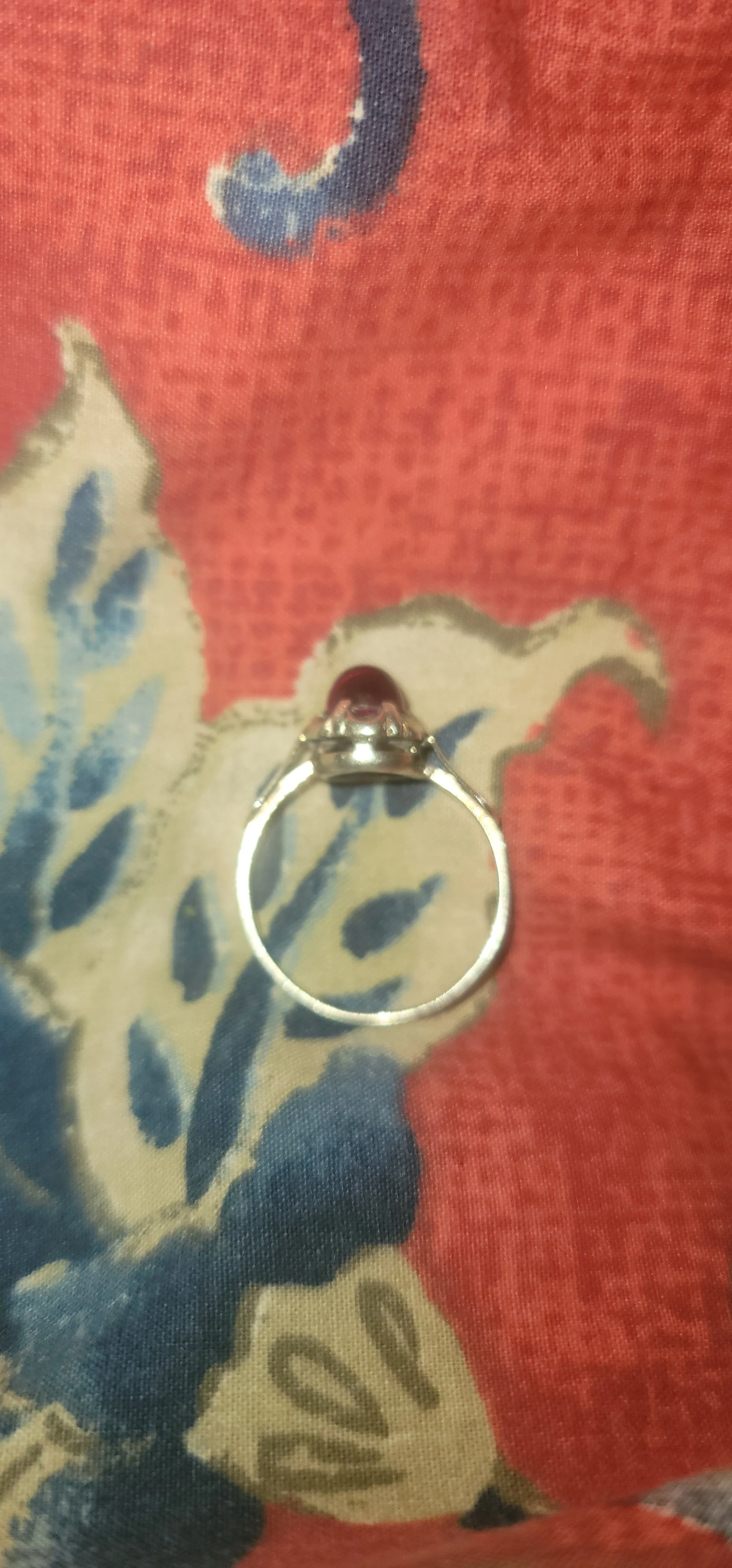
The ring is Soviet-era, made in Ukraine around the 1970s, in 875 silver. That 875 mark matters: it was a standard Soviet silver fineness, and the ring also carries a worn USSR state assay mark, the little stamp the Soviet system put on precious metal it had tested. The stone is a smooth cabochon, no facets, held in a claw setting that is open underneath.
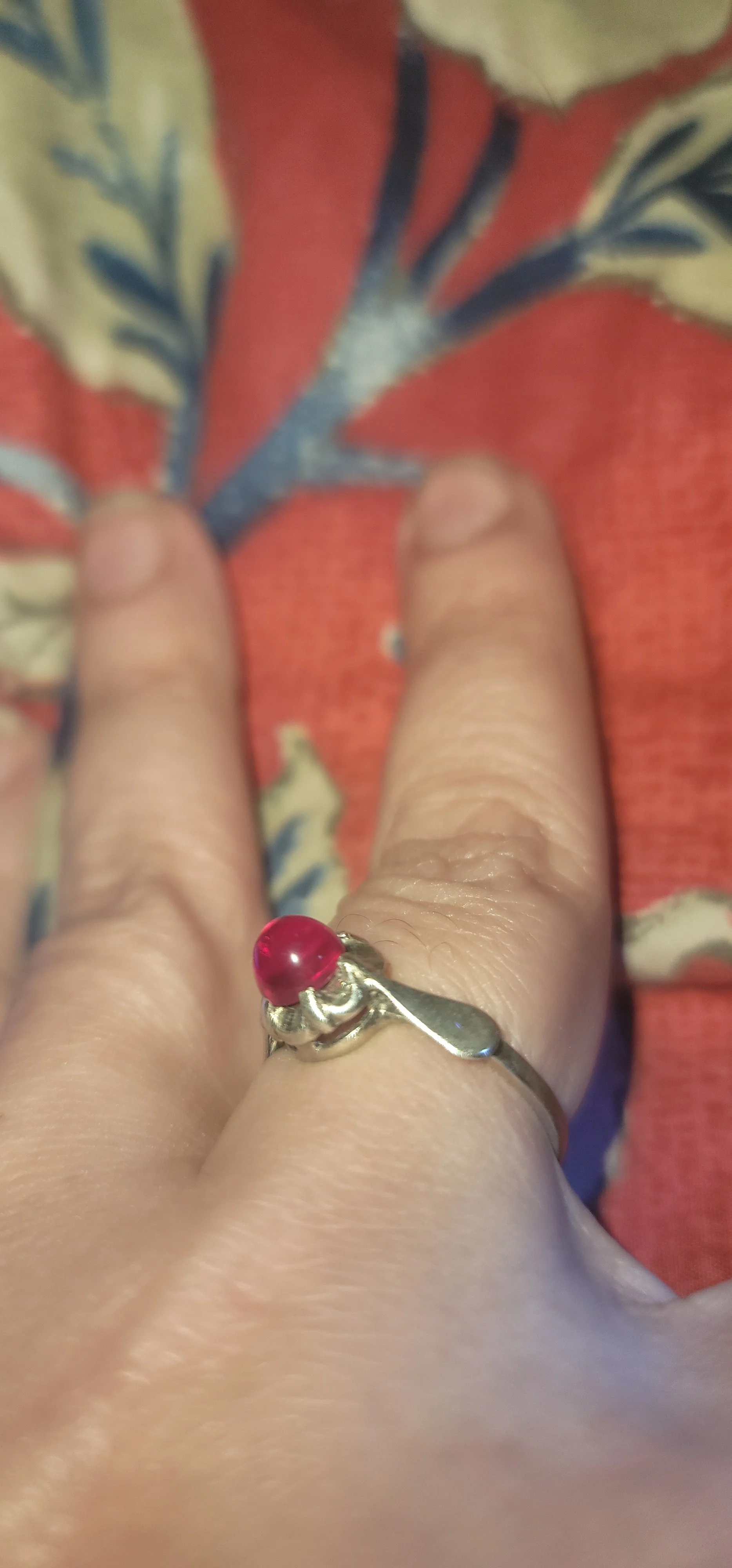
Hold it up to a window and the cabochon lights up like a coal. That glow is the reason I started researching it, and it is the reason a version of this ring now lives in my reference collection instead of my sale stock.
What is flame fusion?
Flame fusion, also called the Verneuil process after the man who perfected it in 1902, grows a crystal by sprinkling powdered material through a very hot flame so it melts and builds up, layer by layer, into a solid crystal rod. Cool that rod down and cut it, and you have a ruby. Chemically it is the same mineral as a natural ruby: corundum, aluminum oxide, colored red by a trace of chromium. What it is not is mined.
The Soviet Union used flame-fusion corundum constantly. Natural ruby was scarce, the lab stones were beautiful and consistent, and Soviet jewelers set them in gold and silver by the millions. If you buy vintage Soviet jewelry with a big, clean, glowing red stone, the odds are overwhelming that the stone is flame-fusion. That is not a defect in the piece. It is the piece's history.
Why does the glow look so strong?
Three things stack up:
The stone is optically clean and iron-free. Flame-fusion corundum grows without the inclusions and iron content found in many mined rubies, so light passes through instead of getting absorbed and scattered. Iron matters twice here, because it also quenches ruby’s fluorescence: iron-rich natural rubies, like many Thai stones, barely fluoresce, while low-iron Burmese rubies are famous for fluorescing in sunlight. Natural ruby is not automatically dull. It depends on the deposit.
The setting is open underneath. That does not feed light into the stone while the ring sits on a finger; the finger is in the way. It matters when the ring is held up to a window or a lamp, which is how I photograph it: light passes straight through the clean stone instead of hitting a closed metal back, and the open gallery under the stone lets light in from the sides as well. A cabochon shape spreads that light instead of throwing it back in sparkles.
Ruby does something extra. The chromium that makes ruby red also makes it fluoresce: it absorbs ultraviolet and blue light and gives red light back. Sunlight carries plenty of both. It is a small part of what you see outdoors, but it pushes the red further.
A word on words: glow is the everyday term, and it is the one in the title because it is the question people actually ask. The accurate term for the light a stone gives off under ultraviolet is fluorescence. It is not phosphorescence, which is an afterglow that continues after the light source is removed. This ring fluoresces. It does not phosphoresce.
Put together: a clean, iron-free stone, an open setting, and a little fluorescence. No mystery left, but the effect is still startling every time.
How can you tell a flame-fusion ruby from a natural one?
Under magnification, a flame-fusion stone can show curved growth lines, like the layers in a vinyl record, left by the way the crystal built up in the flame. Natural ruby never has those. Flame-fusion stones can also hold tiny gas bubbles, and they often look almost too good: very even color, very high clarity, at a size and price a natural stone would never allow. A gem tester and a loupe will get you most of the way. When it matters, a gemologist settles it.
Does a glowing ruby mean it is natural?
No. If anything, it leans the other way. A strong, clean glow in a vintage ring is a hint to check for flame fusion, because lab-grown stones are usually cleaner than natural ones, and a cleaner stone transmits light more strongly. Fluorescence tells you chromium is present and iron is low. It does not certify purity, and it says nothing about origin. What speaks to that is inside the stone: curved growth lines mean it was grown by flame fusion, and its inclusions can point to how, and sometimes where, a natural stone formed.
What is a ring like this worth?
Honest answer: the stone being lab-grown caps the price, and the history carries it. Comparable Soviet flame-fusion ruby rings in silver sell roughly between $45 and $90 depending on condition and size, with strong presentation pushing a good one toward $115 or a bit beyond. You are paying for a well-made piece of Soviet industrial craft with a genuinely beautiful optical trick, not for a rare gemstone. Sellers who price them like natural rubies are telling you a story the stone cannot back up.
Mine is not for sale. It earned its keep as a teaching piece: one ring that demonstrates, in your hand, exactly how flame-fusion corundum handles light. When people ask why I test stones and say plainly what they are, this ring is a big part of the answer. The truth about it is more interesting than the myth would be, and it glows anyway.
If you collect vintage jewelry and want pieces whose stories check out, browse the shop. If glowing stones are your thing generally, my Uranium Fever hub covers the glass side of the same fascination, including how I describe UV-reactive material honestly when its composition is unverified.
Frequently asked questions
Is a flame-fusion ruby a real ruby?
It is real corundum with the same chemistry and crystal structure as a mined ruby. It is lab-created rather than natural, and honest sellers say so. "Real" and "natural" are not the same word in gemology.
Why does my ruby only glow outdoors?
Because the effect needs strong, full-spectrum light. Sunlight delivers far more energy, including ultraviolet, than indoor bulbs do, so both the transmitted-light effect and the fluorescence fade under household lighting.
What does an 875 mark mean on a ring?
It is a fineness mark: 875 parts per thousand silver. It was a standard grade in the Soviet Union, and alongside a USSR assay mark it is a strong clue that a piece is Soviet-era.
Can a natural ruby glow too?
Yes. Natural rubies fluoresce as well, and fine Burmese stones are famous for it. Fluorescence alone never proves a stone natural or synthetic. The internal growth structures are the evidence.
How do I check my own ring?
Look at the back of the setting first. If it is open and the stone lights up against a window, you are seeing transmitted light at work. Then use a loupe and look for curved lines inside the stone. Curved growth lines mean flame fusion. When in doubt, have it tested rather than guessing.